Agentic Commerce and the Post-Purchase Problem
When an AI agent does the buying, who does your customer talk to afterwards?
Agentic commerce has moved from demo to standard in under a year - Instant Checkout in ChatGPT, the Agentic Commerce Protocol, Google's Universal Commerce Protocol and AP2. Almost all of the attention has gone to the buy button. Nearly none has gone to what happens on day three, when something is wrong with an order the customer never placed by hand.
The standards war is already over the interesting part
In the space of a year, buying through an AI assistant went from a thought experiment to a protocol fight with most of the industry in it.
OpenAI and Stripe co-developed the Agentic Commerce Protocol, the open standard behind Instant Checkout in ChatGPT — live first with Etsy sellers, with over a million Shopify merchants including Glossier, SKIMS, Spanx and Vuori announced to follow, and PayPal's ACP server lined up to bring small businesses on at scale. The protocol has picked up 25+ partners including Salesforce, Squarespace and Adobe Commerce.
Google answered with the Universal Commerce Protocol for agent-to-storefront interaction, paired with AP2, an agent payments standard for proving that a real person authorized a specific purchase. Retailers enabling UCP can surface checkout inside AI Mode and Gemini.
Two things are worth noticing. The first is that the protocols disagree about plumbing and agree completely about direction. The second is that every one of them stops at the confirmation screen.
What nobody standardized
A protocol can describe a purchase. It cannot describe the six weeks afterwards. Consider what an agent-placed order does to ordinary post-purchase support:
- Identity is fuzzy. The order may carry a delegated payment credential and an email the shopper does not recognize as "their account". Your usual order-lookup path fails at the first question.
- Consent is contested. AP2 exists precisely because "who authorized what, for how much" became a real question. When a customer disputes an agent-placed order, your team is the one adjudicating it.
- The shopper never saw your storefront. No confirmation page, no order-status page, no returns portal they know how to find. Every policy they did not read is now a support contact.
- Returns get stranger. Single-item agentic purchases are the current norm; multi-item carts are coming. Partial returns, exchanges and subscription starts all have to work for an order placed by software.
- The contact may itself be an agent. Increasingly the entity asking "where is my order" is another assistant, acting for the customer.
Agentic commerce does not reduce post-purchase contacts. It relocates them, strips the context your team relied on, and raises the expectation that resolution happens in the conversation.
Support is becoming an agent-to-agent interface
The service side has moved in the same direction and is further along than most retailers realize. Zendesk AI Agents now operate across messaging, email, voice and AI platforms including ChatGPT and Gemini, carrying shared context between them — so a conversation that begins inside an assistant does not reset when it becomes a ticket. Zendesk's Specialized AI Agents, launched with commerce as the first industry, are explicitly built to help customers shop, manage orders, process returns and exchanges, resolve delivery issues and handle refunds.
Read those two facts together and the shape of the next few years is clear: a shopping agent transacts, a service agent resolves, and the handover between them is your brand experience. If your commerce data is only reachable by a human clicking through an admin console, you are not in that conversation at all.
Four things to get right before this is urgent
- Make order state machine-addressable. Everything an agent needs to resolve — fulfillment, shipment, payment, subscription and returns state — has to be retrievable by API in real time, across every storefront you run, not just the one with a native connector.
- Expose actions, not just data. Refunds, pre-fulfillment order edits, subscription changes and return initiation need to be callable operations. Resolution is an action; an answer is a description of one.
- Solve identity resolution early. Agent-placed orders break email-equals-customer assumptions. Plan for matching on order token, payment reference and delegated identity, and decide now what your automation does when matching is uncertain: escalate, never guess.
- Write the policies down in a form software can follow. Return windows, exception thresholds, goodwill limits and fraud rules stop being tribal knowledge the moment an agent enforces them.
Where agnoStack fits
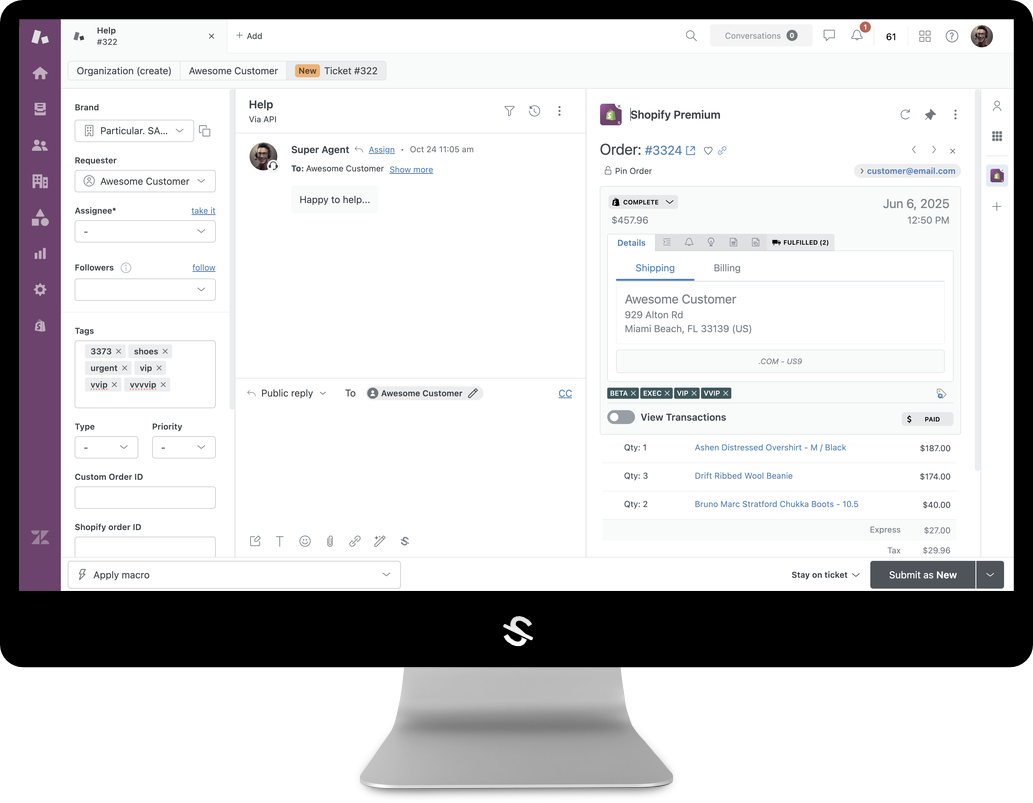
agnoStack normalizes commerce data and actions for Shopify and Shopify Plus, plus the subscription, loyalty, reviews, returns and payment providers around them — one consistent surface for human agents, for Zendesk action flows and for Custom Agents alike.
That matters more, not less, in an agentic world. The retailers who handle agent-placed orders well will be the ones whose post-purchase stack was already callable, already consistent across platforms, and already trusted to take action.
Customer experience doesn't stop at checkout — and in agentic commerce, checkout is the part you no longer control. To talk through what this means for your stack, contact agnoStack or schedule a demo. You may also want agnoStack’s guides to conversational commerce and Zendesk AI Agents.
Empowering Shopify retailers
of all types & sizes to provide faster, more seamless and more intuitive customer support regardless of software stack.